Learn how to speak Hindi through real conversation, not memorized lists.
Private online spoken Hindi classes for adults in the USA who want to talk with family, travel with confidence, follow everyday Hindi, and answer without freezing.

A class built around what you need to say next
You learn Hindi by speaking in small, useful situations: greeting relatives, asking for food, explaining plans, handling travel, and following replies at a natural pace.
Family Hindi
Practice greetings, relationship words, respectful questions, food conversations, festivals, and everyday calls with Indian relatives.
Travel Hindi
Handle hotels, drivers, directions, shopping, temple visits, train stations, numbers, prices, and simple polite requests.
Listening comfort
Train your ear for common phrases, fast replies, familiar accents, and the difference between textbook Hindi and natural speech.
Pronunciation repair
Work on sounds that English speakers often flatten, including dental and retroflex consonants, vowel length, nasal sounds, and sentence rhythm.
Class time is active, guided speaking practice
Minu gives you enough structure to feel safe, then enough live variation to make the Hindi real.
Prompt and answer
You answer short questions, then expand from one-word replies into full Hindi sentences with correction.
Role-play scenes
Practice a family dinner, airport pickup, market visit, WhatsApp call, wedding introduction, or trip-planning conversation.
Listen and respond
Hear a sentence, identify the meaning, repeat the rhythm, and answer in your own words instead of translating silently.
Pronunciation loops
Repeat key words and sentences with focused feedback until your sounds are easier for Hindi speakers to understand.
Story retelling
Use familiar vocabulary to describe your day, a family memory, a movie scene, a recipe, or a travel plan.
Home practice
Leave with short speaking tasks, listening prompts, and reusable phrases so progress continues between live lessons.
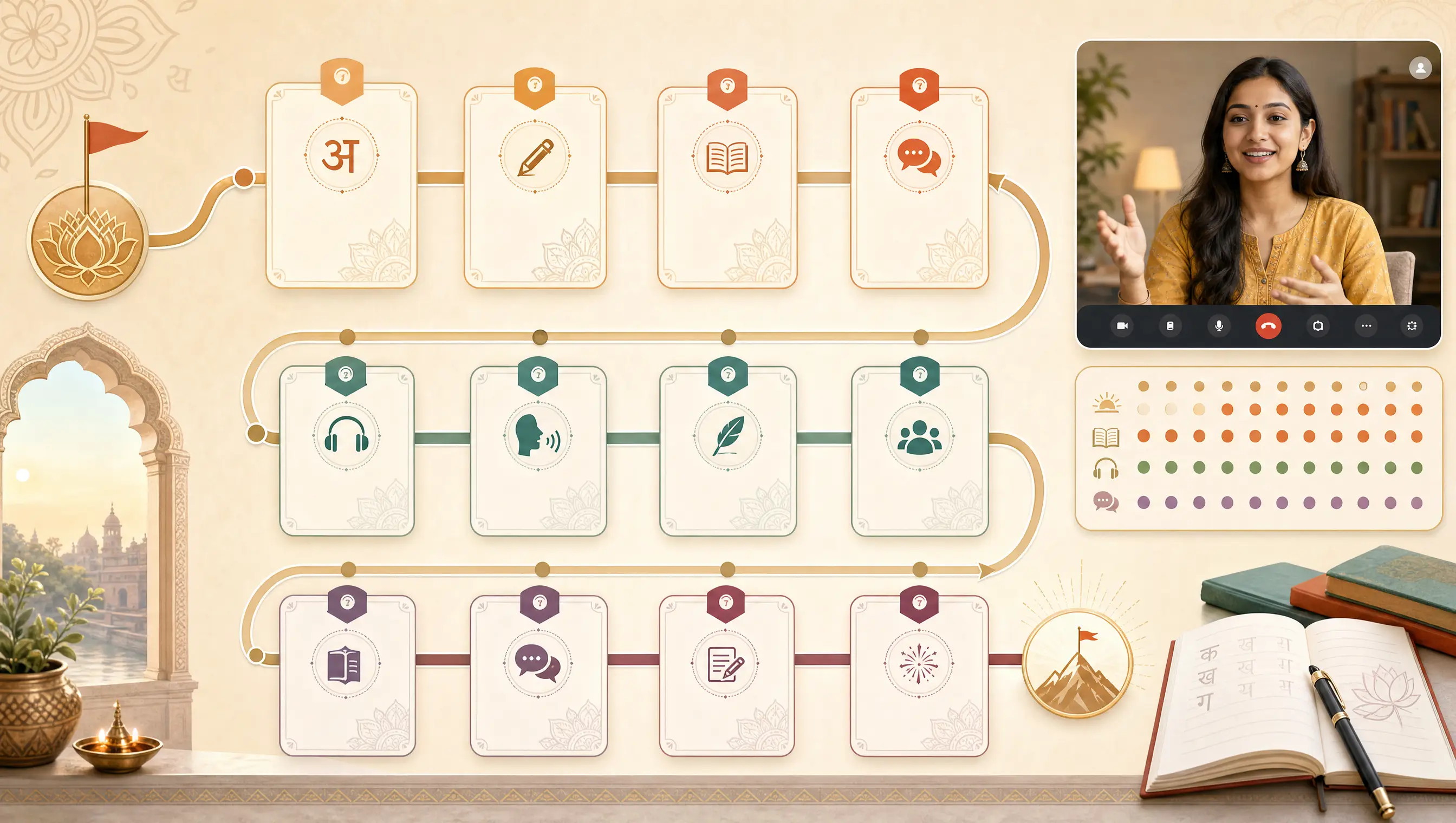
A clear path from hesitant phrases to flexible conversation
ACTFL describes language ability through what learners can do in real-world communication. This class uses that same practical idea: each stage adds new things you can say, understand, and repair.
Speaking improves when your ear improves too
Many adults know more Hindi words than they can use. The missing piece is often hearing the phrase quickly, recognizing the pattern, and producing the sounds clearly enough in the moment.
Pronunciation focus
- Dental and retroflex sound contrast
- Short and long vowel practice
- Nasal endings and common reductions
- Sentence stress and natural rhythm
Listening focus
- Slow, medium, and natural-speed prompts
- Common question patterns
- Family and travel vocabulary in context
- Repair phrases when you miss a word
Choose the conversations you want first
Your lesson plan can lean toward one goal or combine several. The point is to practice the Hindi you will actually use.
Family connection
Introduce yourself, ask about health, talk about food, discuss children, and join small parts of group conversation.
Travel confidence
Use Hindi at airports, homes, markets, restaurants, temples, taxis, and train stations without relying on a translator for every sentence.
Culture access
Understand more from films, songs, stories, festivals, yoga vocabulary, and everyday Indian social cues.
Personal fluency
Move from rehearsed phrases to opinions, memories, plans, preferences, and gentle humor in Hindi.
Keep exploring the Hindi class pages
Hindi Landing Page
Start with the main online Hindi class overview and pricing.
Hindi Tutor Online
See how private tutoring works for adult learners in the USA.
Best Way to Learn Hindi
Compare tutoring, apps, self-study, and conversation practice.
Hindi Course Curriculum
Review the week-by-week path for beginner and conversational courses.
References behind the learning approach
These sources inform the emphasis on functional communication, US adult learners, and Hindi or Devanagari literacy support.
ACTFL Proficiency Guidelines
ACTFL frames proficiency around what learners can do in speaking, listening, reading, and writing in real-world situations.
Pew Research Center
Pew summarizes Indian American demographic context using U.S. Census Bureau data.
U.S. Census Bureau
The Census Bureau reports detailed language use data for languages spoken at home in the United States.
Library of Congress
The South Asian Collection guide points learners and researchers to romanization and Devanagari search strategies.
Questions adults ask before starting spoken Hindi
Are these spoken Hindi classes for complete beginners?
Will I learn how to speak Hindi or mainly grammar?
Can we practice Hindi for my spouse's or partner's family?
Do I need Devanagari for spoken Hindi?
Can classes work across US time zones?
Book a free spoken Hindi trial class
Tell Minu your goal, your current Hindi level, and your US time zone. The first conversation will show you what to practice next.